
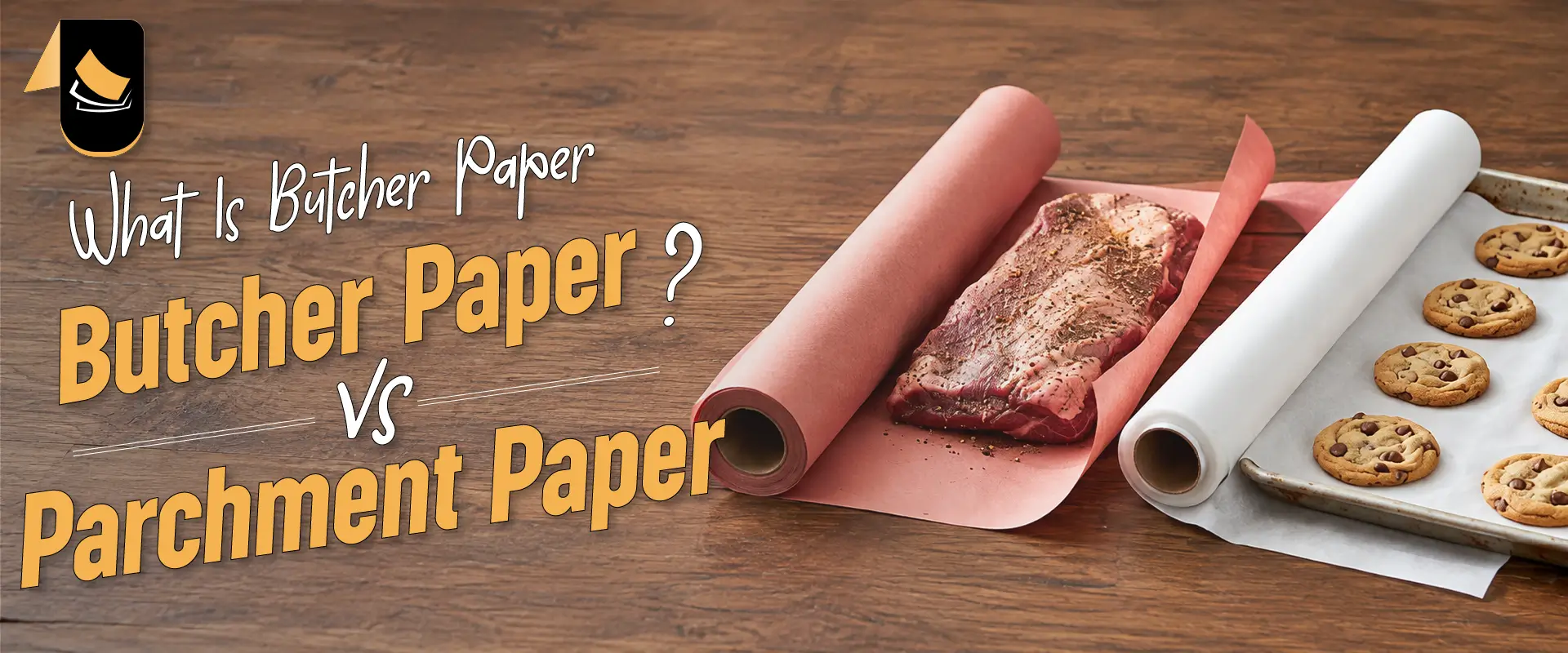
What Is Butcher Paper? Butcher Paper vs. Parchment Paper
Butcher and parchment paper are almost identical in their appearance. Nonetheless, using them in the kitchen can ruin your barbecues or spark literal fire. Although both papers are kitchen essentials, they serve entirely different purposes. One is manufactured to survive the heat of the oven. The other paper is used to give a breathable wrap to the smoked brisket so that it remains juicy and smoky. If you want to make your cooking perfect and avoid a smoky disaster, then you must understand the core difference between these two custom food papers.
Butcher and parchment sheets are both paper-based food-contact materials, but they are different in several aspects. Such as:
- Fiber structure
- Surface treatment
- Barrier behavior
- Heat performance
- Moisture response
- Intended use
The biggest mistake a chef can make is treating these two paper types as interchangeable because they both can wrap food. So let’s read the blog and understand the difference between the two.
What Is Butcher Paper?
It is a purpose-designed paper that is used for wrapping and handling meat. Butcher sheets are manufactured from paper fibers that have controlled thickness and porosity. Its strength and moisture resistance are also quite different from parchment. Usually, butcher paper is manufactured from unbleached kraft paper and other strong fibers; it can withstand folding and food handling without tearing. The performance of this heavy-grade paper depends on specific grades. Butcher paper can be:
- Uncoated
- Treated
- Grease resistant
- Moisture resistant
- Freezer suitable
- Cooking suitable
- Printed
- Colored
- Food-contact compliant
So “butcher paper” is a category of food wrapping paper rather than one chemically identical paper specification.
How Is Butcher Paper Made?
The main difference between all food wrapping papers lies in their different manufacturing processes and GSM. It is manufactured with cellulose fibers that are derived from wood pulp. Below is the manufacturing process of butcher wrapping paper sheets:
Pulp Preparation
In this step, wood fiber is processed to get cellulose fibers. Most of the time, the kraft pulping process is used to get high-quality cellulose fibers. A high-quality fiber impacts the below-mentioned characteristics of the paper:
Fiber characteristics influence:
- Tensile strength
- Tear resistance
- Folding endurance
- Surface formation
- Porosity
Refining
It is a process in which fiber undergoes refining before sheet preparation. The refining process changes the fiber dimensions and fibrillation, which ultimately influences the bonding between individual fibers. If the paper fibers have high bonding, then the resulting paper is also of high quality. However, this bonding between the fibers also impacts the porosity and absorbency of the paper.
Sheet Formation and Pressing
Across the forming system, the paper pulp is distributed. Due to this distribution, water from the fiber network drains and a wet paper web is created. After sheet formation, mechanical pressure removes excessive water from the paper to give a consolidated fiber network.
Drying and Finishing
Manufacturers pass the paper through the cylinders to dry the paper. In drying, most of the final mechanical structure of the paper is formed. Then comes the final finishing stage, where the paper’s surface and barrier characteristics are achieved. Based on the intended use of butcher paper, it undergoes the following steps:
- Calendering
- Coating
- Sizing
- Treatment
- Slitting
- Cutting
- Printing
The overall strength of custom butcher wrapping paper lies in several factors that are listed in the table:
| Property | Material Base | Main Function | Technical Metric | High Quality |
|---|---|---|---|---|
| Basis Weight | Wood pulp | Measures mass | Area density | High density |
| Tensile Strength | Fiber bonds | Resists pulling | Breaking point | Strong network |
| Tear Resistance | Cellulose web | Prevents rips | Edge safety | Dense fibers |
| Burst Strength | Sheet matrix | Resists pressure | Rupture limit | Solid cohesion |
| Wet Strength | Added resins | Withstands moisture | Liquid defense | Treated paper |
Why Is Butcher Paper Often Porous?
The porosity of any material is due to the microscopic spaces between the fibers, and the same goes for butcher paper sheets. Due to the porosity, butcher wrapping paper behaves differently from highly coated or plastic-based packaging films. This is an essential feature of barbecuing meat that needs the permeation of smoke. These pores in the paper influence the following:
- Air permeability
- Moisture movement
- Vapor transmission
- Absorption
- Drying behavior
What Is Pink Butcher Paper?
There are different grades of butcher paper, and one such is pink butcher paper. It is also known as peach butcher sheets, which are commonly used to barbecue meats. The characteristic color of pink paper is due to the coloring used in the manufacturing process. The popularity of BB comes from the recombination of:
- Strength
- Wrapability
- Breathability
- Grease handling
- Cooking suitability when specifically manufactured for that use
What Is Parchment Paper?
Parchment paper is also a cellulose-based wrapping sheet that is manufactured for high-heat applications. The defining feature of parchment paper is its heat resistance and non-stick surface. It undergoes silicone coating, and the formulation of which varies based on the formulation selected by the manufacturer. Silicone treatment of the paper is associated with a familiar nonstick characteristic that is associated with baking parchment. The manufacturing process is conducted such that the finished sheet has the following characteristics:
- Low adhesion
- Grease resistance
- Improved release
- Heat resistance
- Controlled moisture interaction
How Is Parchment Paper Different at the Fiber Level?
Both are manufactured diabellus fiber, but parchment undergoes an additional processing step. This step modifies the surface properties. Acid patching is done to alter the surface properties of the paper, such as making sheets denser and more resistant. Silicone coating also influences the features of parchment. The typical non-stick feature of parchment comes from the paper substance and surface treatment.
What Does Silicone Do On Parchment Paper?
Parchment is coated with silicone that changes the surface energy of parchment. This increases adhesion between paper and the food, which makes parchment perfect for non-stick application. Silicone is a very thin layer as compared to the paper thickness but has a major effect on the resulting sheets. It can contribute to the following:
- Release performance
- Grease resistance
- Moisture resistance
- Thermal stability
Technical Comparison Of Butcher Paper vs. Parchment Paper
The major differences between the two are mentioned in the table. In addition to their surface, they are significantly different in their applications and strength:
| Property | Butcher Paper | Parchment Paper |
|---|---|---|
| Base material | Cellulose | Cellulose |
| Primary purpose | Wrapping | Baking |
| Typical structure | Fiber network | Treated fiber network |
| Surface | Paper-like | Non-stick |
| Silicone | Usually absent | Often present |
| Porosity | Often higher | More controlled |
| Grease resistance | Grade-dependent | High |
| Release | Low to moderate | High |
| Heat suitability | Grade-dependent | Designed for cooking |
| BBQ suitability | Selected grades | Limited |
| Baking suitability | Limited | Excellent |
| Wrapping strength | High | Moderate |
| Food-service use | Common | Secondary |
| Printability | Generally good | Treatment-dependent |
Difference In Barrier Properties
The barrier properties are where the difference becomes particularly evident. This behavior is acquired due to differences in the manufacturing process and raw materials. It depends on the following:
- Fiber density
- Porosity
- Coating
- Sizing
- Calendering
- Moisture content
- Surface treatment
Oxygen Transmission
The pores in the paper are the reason for gaseous exchange. A Sprachmente paper is treated with silicone, and its surface is altered. Due to this alteration, it blocks oxygen in the same way as aluminium foil does. On the other hand, butcher sheets have highly breathable surfaces that allow paper to breathe.
Water Vapor
Cellulose is highly hygroscopic and has the ability to absorb moisture. This moisture absorption changes paper properties. However, application of coatings can alter this behavior of cellulose. At higher humidity, paper can experience:
- Reduced stiffness
- Lower tensile strength
- Dimensional changes
- Increased flexibility
Grease Resistance
It is another property of butcher and parchment that differs significantly between the two. Butcher paper has a specific grade that slows down grease penetration. On the other hand, parchment is grease-resistant and inhibits easy absorption of fat. That is why parchment is the best option when:
- Butter-rich pastries
- Cookies
- Roasted foods
- Fatty meats
- Baked goods
Why Can You Bake With Parchment But Not Any Butcher Paper?
This is one of the major differences that must be kept in mind: butcher paper is not safe for baking. As parchment has silicone, it is highly resistant to heat and does not leach any toxins into the food. Butcher paper can be used for high-heat applications if the manufacturer has it mentioned. However, all grades of butcher shells shall not be used for direct heat applications like smoking mats. The temperature performance of the paper depends upon the following factors:
- Paper composition
- Moisture content
- Surface treatment
- Silicone system
- Coating
- Heating method
- Exposure time
- Manufacturer specifications
Why Does Butcher Paper Work for Smoking Meat?
As butcher paper is permeable, it allows more movement of moisture and gases. This feature of the paper can influence the development and preservation of the meat’s surface bark. The exact cooking of the meat depends on the paper and the moisture content. Besides this, humidity and temperature also impact the process and can be affected by paper type. When a piece of meat is wrapped, the paper can:
- Reduce direct surface drying
- Capture some rendered fat and moisture
- Reduce evaporative cooling
- Allow some vapor movement
- Protect the exterior during handling
Why Parchment Is Not a Direct Substitute for BBQ Butcher Paper
The silicone-treated surface of parchment changes how moisture and fats interact with the paper. Parchment is manufactured for release and cooking. However, BBQ butcher paper is manufactured to give it wrapping properties and enhance permeability. If you substitute parchment with butcher paper or vice versa, you may face the following issues:
- Surface moisture
- Steam movement
- Grease interaction
- Bark development
- Handling characteristics
Bottom Line
Both papers are manufactured with the same fundamental material, i.e cellulose fiber. However, their manufacturing process and raw coatings are different from each other. Butcher is non-woven, while parchment wrapping paper is a coated sheet of paper. That is why both are different from each other in their applications. No matter which one of the two you need. You can contact Custom Grease Paper. A brand that manufactures some of the finest quality, food-grade packaging papers at wholesale rates.