

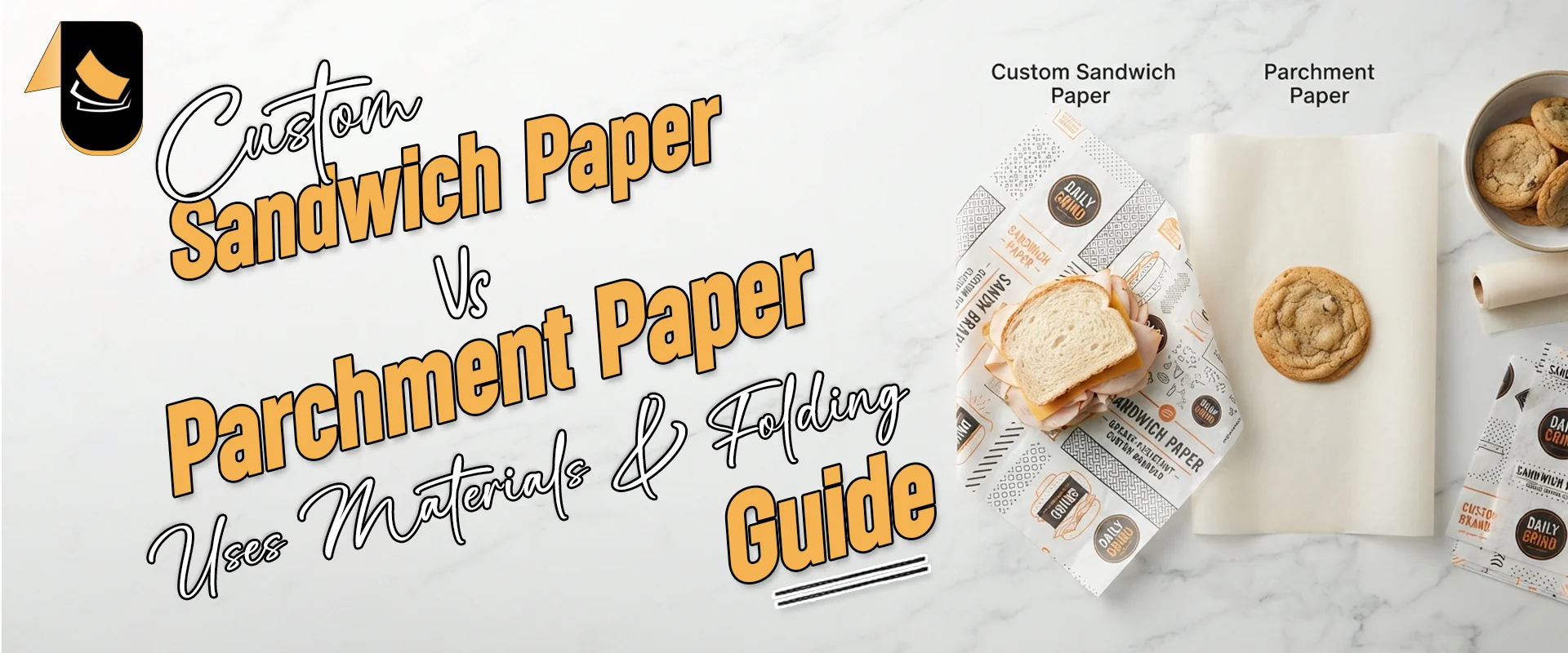
Custom Sandwich Paper vs. Parchment Paper: Uses, Materials & Folding Guide
Many people think that sandwich paper and parchment paper are the same in function and are made from the same material. But this is wrong; both papers are different, have different properties, and are manufactured from different materials. Selection of wrong paper can affect the food presentation, quality, and cost. Sandwich paper is typically used for wrapping cold sandwiches and food. Parchment paper is used for baking or steaming and can handle oven heat.
What Is Sandwich Paper?
Custom sandwich paper is used to wrap and protect food. It is also known as wax paper or butter paper and is used to wrap cold food like sandwiches, cheeses, and baked items. It is coated with wax that provides protection against moisture and a smooth feel to the paper. It is a lightweight paper that is typically not suitable for oven use.
Uses Of Sandwich Paper
There are different uses of sandwich paper:
- Used to wrap different foods like sandwiches, burgers, and burritos.
- Gives a presented and delicious serving look to the food.
- Resist oil and butter to keep your food from getting soggy.
- It is used for short-term food storage.
- Cost-effective for high-volume wrapping.
- Available in various sizes.
- Different designs can be printed on the sandwich paper to make it vibrant.
- Commonly used by different restaurants to serve their food.
- Sandwich paper is safe and convenient for handling.
Material Usage For Sandwich Paper
Sandwich paper is made from a highly durable material that passes through different steps:
- Raw material preparation: Wood pulp is used that is acquired from breaking down wood into fibres.
- Pulping: In this method, raw material is broken down into fibres for paper making.
- Stock preparation: Water and other items are added to achieve the desired length and durability.
- Coating: To make the paper grease-resistant, different coatings are applied to the paper.
- Drying: After coating, the sheets are passed through a heat-drying process to remove the moisture.
- Cutting & Finishing: Sheets are cut into your desired size and dimensions.
In this process, we always ensure that sandwich paper meets various authorities’ standards, such as:
- FSC & FDA approved
- SGS certified
- ISO9001 licensed
Folding Guide For Sandwich Paper
Wrapping sandwiches is not as difficult a task as you think. You can fold it within a minute and get restaurant-style packed sandwiches. Different methods that you can use to wrap a sandwich. The styles are mentioned below; follow these simple steps:
- Tri Fold: Place sandwich paper on a surface and join one corner to the opposite corner so they touch each other. Wrap the paper from one corner of the sandwich to the other so that it fits properly. Bring the bread to the corner that is near the first layer. Seal the lower part with tape to prevent leakage.
- Pocket Fold: Place your sandwich on a surface and put the middle in the pocket. Lift one corner of the paper from the other side and align the bottom part of the paper with the middle corner; fold the lower side of the sandwich with the other side. To prevent the sandwich from contamination, you can seal it by folding the corners.
- Envelope Fold: Place the sandwich in the center of the paper and bring the upper corner over the lower. Fold the last corner of the paper upwards and press both sides downwards to tuck inside.
- Diagonal Fold: Align the middle part of the sandwich with the middle part of the paper. Lift one side of the paper and fold it. Bring the other corner of the paper and place it over the first fold.
What Is Parchment Paper?
Parchment paper is called baking paper because it is used for baking and cooking and can resist oven heat. Different bakeries use it to bake their items. It is also manufactured from high-quality materials to meet requirements. Silicone coating helps the paper withstand high oven temperatures.
Uses Of Parchment Paper
Different uses of parchment paper are given below:
- Used to line baking pans to prevent the food from sticking to the pans
- Perfect for baking cookies, cakes, and bread
- Can withstand oven temperatures of 450 – 500 F
- Parchment paper is reusable
- Ecofriendly option
- It has a high cost
- Reduces the carbon footprint of your brand
- It has a tear-resistant structure
- Reduces cleanup by preventing sticking
Material Usage For Parchment Paper
This paper is made from durable kraft materials that are sustainable for the environment. Paper passes through different processes:
- Kraft is the base material of all the food wrapping papers that is obtained from wood pulp.
- The resulting paper pulp is soaked in acid to smooth and strengthen the surface.
- When the paper dries, a thin layer of silicone coating is applied to enhance the heat resistance.
Types of parchment paper:
- Bleached paper: white due to chemicals
- Unbleached: brown and sustainable for the environment.
Folding Guide For Parchment Paper
Folding parchment paper according to the desired pan shape is not rocket science, its very easy method. You can cut paper directly with scissors or trace within the shape and can get pre-cut shapes of paper. The following guide for pan shapes:
- Lining round pans: Fold the sheet into quarters and then fold diagonally. Cut along the edge to get the desired circle shape.
- Square or rectangle pans: Outline the shape of the pan, square or rectangle, on the paper, then cut it to place in the pan to get a perfect shape.
- Lining loaf pans: Use the same method as for square or rectangle, outline with the pan and then cut out and place them inside.
- Lining muffin tins: Cut small circles of parchment paper slightly larger than muffin cups. Cut down into quarters and cut down each line to almost the middle. Press them in the cups so the corners fold naturally.
The key difference between sandwich paper and parchment paper
| Feature | Parchment Paper | Sandwich Paper |
| Primary Coating | Food-grade silicone | Paraffin wax, polyethylene (PE), or light greaseproof treatment |
| Heat Resistance | High | Very Low |
| Primary Purpose | Baking, roasting, and steaming food | Wrapping sandwiches, burgers, pastries |
| Grease & Moisture | Repels both grease and moisture | Blocks grease and moisture for short-term holding |
| Texture & Foldability | Crisp, smooth | Thin, flexible |
| Cost | More expensive | Less expensive |
Wrapping Up!
Sandwich paper is perfect for cold food wrapping, not for oven use. Parchment paper is used for baking and cooking and has the property to withstand high oven temperatures. Choose the right paper according to your requirements for any disaster or hurdle protection. To get more information about any paper, you can contact us through our Custom Greaseproof Paper website.